 by Don Lindsey
MRP (Material Requirements Planning) took shape in the 1960s, but its impact is anything but outdated. Its role is central to today’s ERP systems. MRP has consistently delivered what manufacturers need most: clear coordination and control over materials and production. While technologies have evolved, the fundamental logic of MRP remains relevant and indispensable. It is the foundation that modern manufacturing continues to build on.
Where It All Began: The Birth of MRP
MRP emerged in the early 1960s as manufacturers began adopting computer technology to solve a critical operational problem: determining which materials were needed, in what quantities, and when. One of the earliest and most notable implementations occurred at Black & Decker in 1964, utilizing an IBM-based system. Other organizations—including Rolls-Royce, General Electric, Twin Disc, Markem, Steelcase, and American Sterilizer—also played significant roles in advancing MRP concepts and practices.
The Innovators Who Shaped MRP
Although Joseph Orlicky is widely regarded as the principal architect of modern MRP—particularly in the areas of dependent demand, bill-of-materials (BOM) explosion, and time-phased planning—MRP’s development was a collaborative effort. Early contributors included the American Bosch engineering team (1959), the J.I. Case team (1961–1962), Dick Alban at Black & Decker, and thought leaders such as George Plossl and Oliver Wight.
The Questions That Still Drive Today’s Planning
Fundamentally, MRP addresses three important questions, as Oliver Wight succinctly put it: What do I have, what do I need, and what do I need to get? Exception management is a similar principle. It focuses attention on deviations and problems rather than routine operations.
The Shift to Proactive Planning
The introduction of MRP transformed inventory management from a manual, reactive process into structured, future-looking planning.
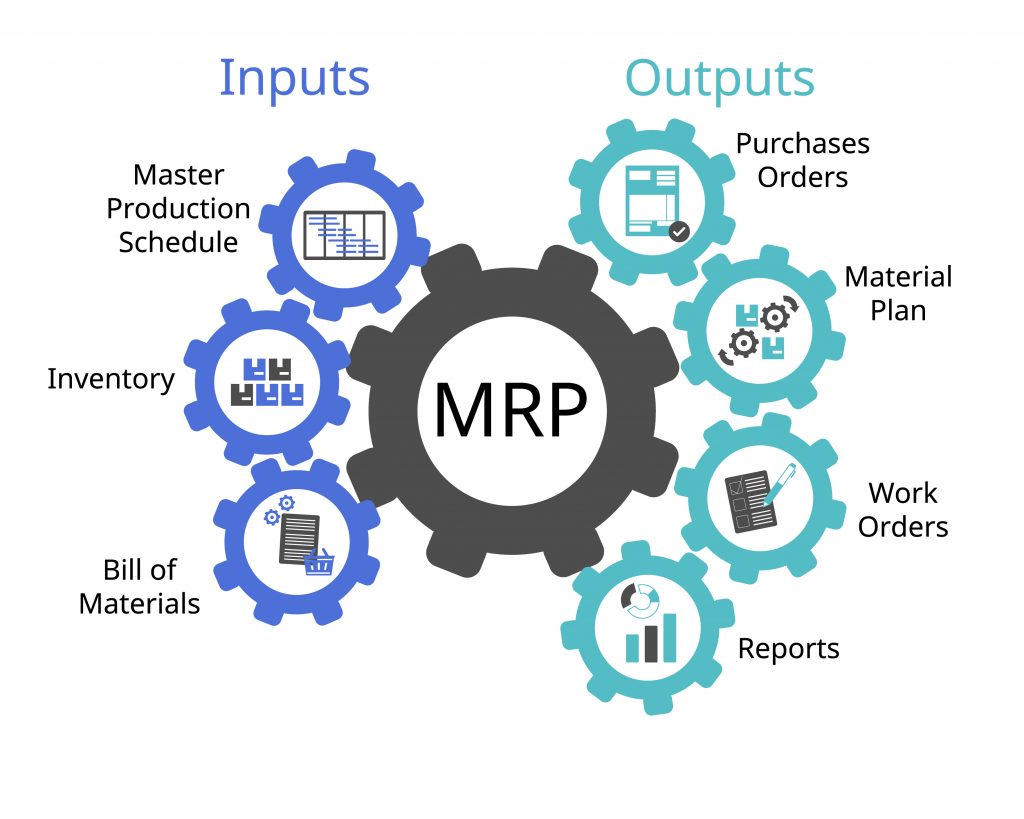
Before MRP, organizations relied on card-based systems, reorder-point methods, and planners’ experience. MRP introduced a systematic approach by integrating the Master Production Schedule (MPS), inventory data, and bills of materials, enabling companies to align material supply with production needs. The result? Greater certainty, lower inventory levels, improved material availability, better customer service, and more operational efficiency.
From MRP to ERP and Other Modern Methods
In the 1980-90s, MRP evolved into MRP II (Manufacturing Resource Planning) and finally to ERP (Enterprise Resource Planning). These systems included capacity and labor planning, shop floor control, and the integration of purchasing, finance, sales, and distribution with manufacturing. However, MRP remains the core logic, and manufacturers continue to depend on it.
Other planning methods have been developed, such as Reorder Point (ROP) and Kanban. More advanced approaches—Demand Driven MRP (DDMRP), Advanced Planning and Scheduling (APS), and Sales, Inventory, and Operations Planning (SIOP)—introduce inventory buffers, finite-capacity constraints, scenario modeling, and cross-functional alignment.
These methodologies don’t replace MRP; they complement it and continue to build upon its logic.
Why Every ERP Relies on MRP
The lasting relevance of MRP lies in its ability to align demand and supply, integrate core master data, and coordinate activities across an enterprise: sales, planning, procurement, warehousing, and production. MRP remains embedded in virtually all ERP systems, and companies rely on its ability to output planned orders, purchase recommendations, work orders, production schedules, and exception reports.
The Takeaway: You Don’t Replace MRP—You Use It Better
Ultimately, while newer planning techniques improve responsiveness and execution, MRP remains the foundational framework for converting customer demand into synchronized, time-phased material and production plans across manufacturing enterprises. We need to learn how to use it.
Don Lindsey, CFPIM, CIRM, is a knowledgeable Implementation Project Manager, Trainer, and Business Analyst. He has been an implementation manager on several large, complex ERP projects and has worked with ERP systems since 2007 in Manufacturing, Systems Management, Service & Support, and Finance. Don has a diversified background in various manufacturing industries, from Medical to Electronics to Industrial to Consumer Products. He has spoken for many years at the APICS Conferences, having taught in the APIC Certification program at California State University at Fullerton for over 20 years.